

Posted by Spartacus on 6th Nov 2026
The Second Amendment Is Bigger Than Guns: Court Rulings Set the Stage for a Landmark AR-15 Decision
Federal courts strike down restrictions on switchblades and body armor as the Supreme Court prepares to take up one of the most consequential Second Amendment cases in years.
The fight to defend the Second Amendment is expanding beyond firearms themselves—and two recent court decisions could help shape the future of constitutional protections for millions of Americans.
On Wednesday, federal judges delivered victories for individual liberty by striking down restrictions on switchblade knives and personal body armor. Both rulings centered on a fundamental question: What does the Second Amendment mean when it protects the right to keep and bear arms?
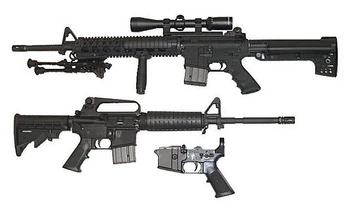
The decisions arrive at a particularly important moment. The U.S. Supreme Court is preparing to hear Viramontes v. Cook County, a case that could determine whether AR-15-style rifles qualify as constitutionally protected arms.
For gun owners, the implications could extend far beyond one particular rifle. The legal principles at stake could influence future challenges to restrictions on ammunition magazines, knives, body armor, suppressors, and other equipment used for lawful self-defense.
The Second Amendment Protects More Than a Narrow List of Weapons
For years, gun-control advocates have attempted to distinguish between firearms they consider acceptable and those they believe should be prohibited.
The problem with that approach is that the Constitution does not grant government officials unlimited authority to decide which commonly owned weapons Americans may possess.
The Second Amendment states that the right of the people to keep and bear arms shall not be infringed. The central legal question is how courts should interpret that protection when governments attempt to prohibit particular weapons or impose restrictions on their possession.
Two Supreme Court decisions are especially important to this debate: District of Columbia v. Heller (2008) and New York State Rifle & Pistol Association v. Bruen (2022).
In Heller, the Supreme Court affirmed that the Second Amendment protects an individual right to possess firearms for lawful purposes, including self-defense. The decision also recognized constitutional protection for weapons commonly used for lawful purposes.
Fourteen years later, Bruen established a historical-tradition test for evaluating firearm regulations. Under that framework, when the Second Amendment's text covers an individual's conduct, the government must demonstrate that its restriction is consistent with the nation's historical tradition of firearm regulation.
These principles are now influencing cases involving weapons and defensive equipment that extend beyond conventional firearms.
Switchblades and Body Armor Win in Federal Court
The Fifth Circuit Court of Appeals ruled that federal restrictions on the interstate commerce of switchblade knives violated the Second Amendment.
The court determined that switchblades qualify as protected arms and concluded that the government had failed to establish a sufficient historical tradition supporting the specific restrictions challenged in the case.
A separate federal ruling in the Western District of New York struck down the state's restrictions on personal body armor.
New York had argued that body armor was a tactical accessory rather than an arm protected by the Second Amendment. The judge rejected that argument, relying on Heller's broader understanding of constitutionally protected arms.
The court also concluded that the state had failed to demonstrate a sufficient historical tradition supporting its restrictions on civilian purchases of body armor.
Although the cases involve different laws and different types of equipment, both decisions highlight an important principle: Constitutional protections cannot be defined solely by the government's preferred classification of a weapon or defensive tool.
These rulings do not automatically settle every future dispute involving knives, armor, or firearms. However, they demonstrate how courts are applying the Supreme Court's Second Amendment framework to modern restrictions.
The Supreme Court's AR-15 Case Could Change the Debate
The next major battle centers on Viramontes v. Cook County.
The case challenges Cook County's ban on so-called "assault weapons" and raises a fundamental question about whether AR-15-style rifles fall within the category of arms protected by the Second Amendment.
The Seventh Circuit previously upheld the challenged restrictions, reasoning in part that AR-15-style rifles were comparable to machine guns and therefore fell outside the category of protected arms.
Second Amendment advocates strongly dispute that reasoning.
George Lyon, a Second Amendment attorney quoted in the Fox News report, argued that the Seventh Circuit was wrong to treat AR-15-style rifles as equivalent to machine guns for purposes of determining whether they qualify as protected arms.
The distinction matters. AR-15-style rifles are semiautomatic firearms, meaning they fire one round with each pull of the trigger. They are not machine guns simply because they share certain design characteristics.
The Supreme Court's consideration of Viramontes could help resolve this disagreement and clarify whether governments may prohibit a class of firearms commonly owned by law-abiding Americans.
For supporters of the Second Amendment, the argument is straightforward: A firearm does not lose its constitutional protection simply because politicians give it a controversial label.
Why These Cases Could Affect More Than the AR-15
National Association for Gun Rights President Dudley Brown believes the Supreme Court's decision could influence challenges to other restrictions on weapons and defensive equipment.
That could include ammunition magazines, automatic knives, and body armor.
National Rifle Association public affairs director Justin Davis likewise pointed to a broader legal dispute over what qualifies as an arm protected by the Second Amendment, including litigation involving suppressors, magazines, stun guns, and pepper spray.
The underlying question is whether constitutional protection should be limited to a narrow list of weapons familiar to the Founding generation or applied according to the principles established by the Constitution and the Supreme Court.
Davis offered a useful comparison with the First Amendment. Americans do not interpret freedom of speech as protecting only newspapers, books, and public speeches simply because modern communication technologies did not exist when the Constitution was adopted.
The same interpretive challenge arises with the Second Amendment.
The Founders could not have anticipated every modern firearm or defensive technology. The question is whether the constitutional principles they established protect modern arms used for lawful purposes.
If the Supreme Court reinforces a broad understanding of protected arms in Viramontes, that reasoning could become important in future challenges to restrictions on other commonly possessed weapons.
Bruen's Historical Test Remains Central
The recent rulings also demonstrate the continuing influence of Bruen.
Under that decision, governments cannot simply defend a firearm restriction by claiming it advances public safety. When the Second Amendment's text covers the conduct at issue, the government must justify the regulation by demonstrating consistency with the nation's historical tradition of firearm regulation.
That does not mean every modern restriction is automatically unconstitutional. Courts must examine the particular law, the conduct it regulates, and the relevant historical evidence.
But it does mean that governments must do more than assert that a weapon is dangerous or politically unpopular.
They must establish that the challenged restriction is consistent with the Constitution as interpreted by the Supreme Court.
For gun-rights advocates, that requirement represents a significant change from approaches that gave lawmakers broad discretion to determine which firearms could be prohibited.
A Defining Moment for the Second Amendment
The recent switchblade and body armor rulings are important in their own right. But their broader significance may become clearer as the Supreme Court considers Viramontes v. Cook County.
If the Court rules that AR-15-style rifles are protected arms under the Second Amendment, the decision could undermine the legal foundations of existing bans and strengthen challenges to similar restrictions elsewhere.
It could also reinforce the principle that constitutional protections cannot be withheld simply because a particular weapon has become the target of political campaigns.
The outcome remains uncertain, and the Supreme Court's eventual ruling will depend on its assessment of the constitutional text, historical evidence, and relevant precedent.
Nevertheless, the direction of the legal debate is significant.
The Second Amendment is not merely a provision protecting a narrow category of traditional firearms. It raises a broader question about the right of law-abiding Americans to possess arms for lawful purposes—and the limits of government power to restrict that right.
The real issue is not whether politicians approve of the AR-15, switchblades, or body armor. It is whether the Constitution permits the government to prohibit or restrict them in the first place.
As the Supreme Court prepares to address the AR-15 question, the consequences could reach well beyond one rifle. The ruling may help define the scope of the Second Amendment for a new generation—and determine whether constitutional protections remain meaningful when the weapons involved become politically controversial.